
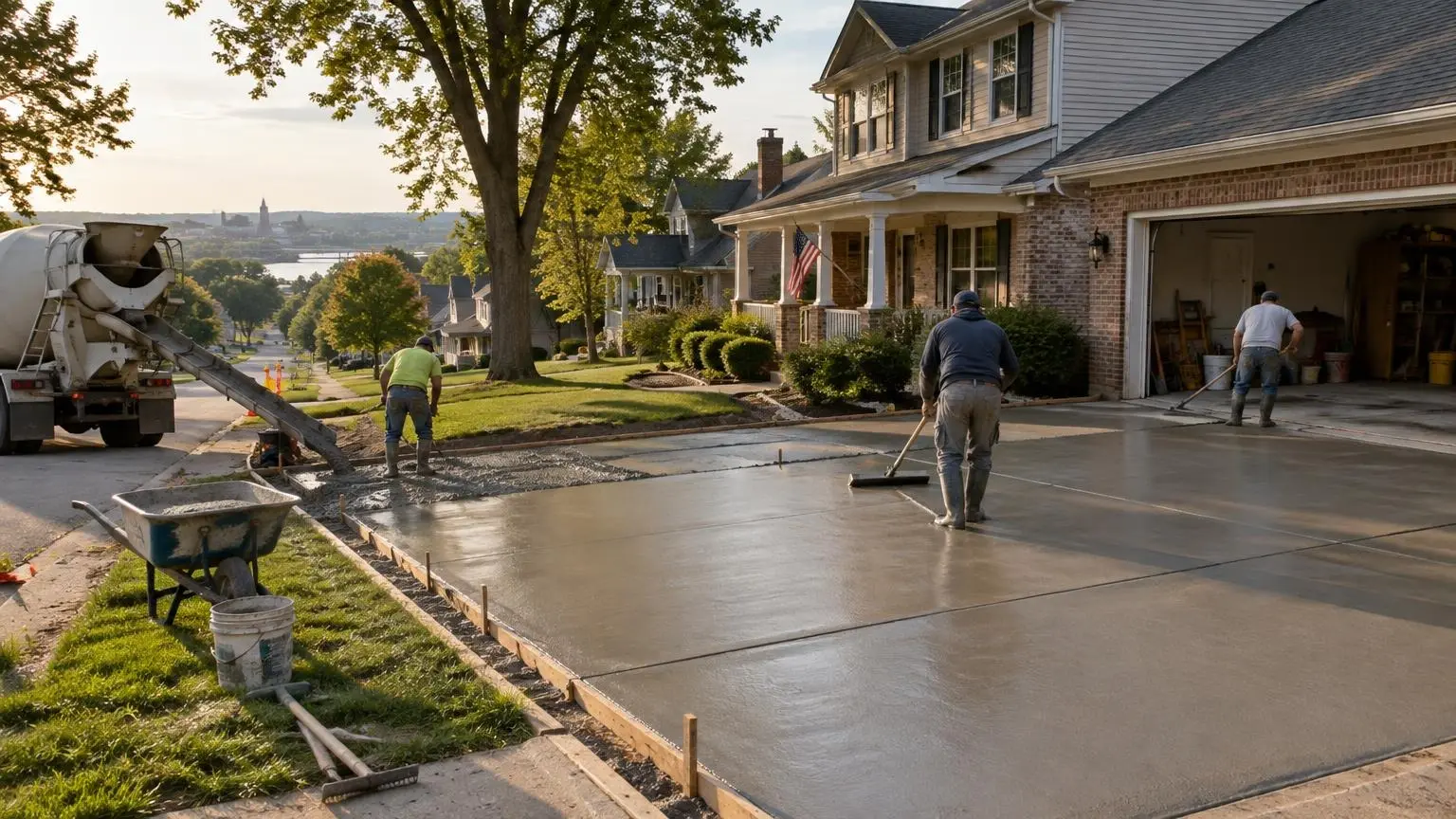
Tear-out, replacement, widening and new pours
Concrete Driveways in Lafayette, IN
Pitched to shed meltwater, mixed to resist brine, and level where it meets the garage.
- No-cost site visit, then a written price broken out line by line
- Outdoor pours use air-entrained mix over compacted stone, with joints laid out ahead of time
- Permit and right-of-way rules looked up for your street before a date is set
Driveways That Handle Lafayette Winters
Concrete Driveways in Lafayette take daily traffic, the odd delivery truck and a whole season of brine. Street crews pretreat city roads with salt brine ahead of storms and begin salting once snow builds up, and every trip in and out carries a little of it onto the slab. Combine that with January lows that average about 18°F and a March that thaws and refreezes over and over, and a drive poured with the wrong mix or over a weak base starts showing it in a few winters. Most of what decides how long a new driveway lasts is done before the ready-mix truck arrives.
When a driveway is past saving
- Flaking: patches of the top layer peel off, usually worst where cars sit and drip slush.
- Cracks that spread, branch out or step up so one side sits higher.
- A dropped apron at the garage that sends water toward the door or freezes into a lip.
- Seasonal heave: panels that rise in winter and settle back in summer, a clue that wet soil sits underneath.
- Crumbling edges where tires roll off the side, typical of older drives poured thin.
Fine hairline cracks show up in almost every slab and mean little. Wide, offset cracks together with flaking across most of the surface mean the concrete itself is failing, and patching will not last.
Building it right
Thickness and stone base are settled first. HomeGuide's driveway guide calls for no less than 4 inches of concrete for everyday cars, 5 to 6 inches where RVs or heavy trucks run, and edges thickened to 6 to 8 inches. A layer of compacted gravel goes underneath. Around Lafayette, where many soils stay wet near the surface in spring, soft or muddy pockets get dug out and backfilled with stone rather than poured over, and the grade is set to send water to the street or lawn and never toward the house.
For the slab, we order an air-entrained mix meant for exterior work. Steel bars sit on chairs so they end up mid-depth, where they can hold any crack closed, and control joints are tooled or sawn at intervals that suit the thickness. The surface gets a broom texture running across the line of travel, which gives tires and boots something to grip on a slushy morning.
Widening and extra parking
Plenty of older houses near downtown Lafayette came with a narrow, one-car drive. Making it wider means pinning the new section to the old edge with dowels or separating the two with an isolation joint, matching the grade, and avoiding a new low spot where water would sit. Sometimes the original slab is worn enough that a full replacement costs only modestly more and looks far better; when that is the case, we price both so you can choose.
The stretch by the street
The approach between the street and the sidewalk usually lies in the public right of way. West Lafayette's City Engineering Department issues a right-of-way permit for construction there, and work cannot start until it is in hand. Lafayette's Contractors Corner page says a permit is needed whenever soil is disturbed between the sidewalk and the street. Shadeland includes a driveway permit on its building permit checklist. Which of these touches your address gets confirmed early and built into the schedule.
The first months
Light foot traffic can usually go on after a day or two; vehicles should wait about a week. HomeGuide advises holding off on sealer until the slab has cured 28 to 30 days, then resealing every 2 to 3 years, and lists sealing at $1 to $3 a square foot. Keep salt off the drive its first winter and spread sand for grip instead. In later winters, clear snow before it packs into ice, go easy on deicers and turn downspouts so they drain away from the concrete.
What Goes Into a Driveway Replacement
A full replacement runs from the street approach up to the garage floor.
Breaking out the old drive
Existing concrete or asphalt is busted up, loaded and taken off site.
Subgrade and stone
Soft soil comes out, the grade is set to drain, and gravel is compacted layer by layer.
Forms and steel
Forms go in at finished height, with bars raised on chairs so they sit inside the slab.
Placing and texture
Air-entrained concrete is placed, floated and given a cross-slope broom texture.
Joints and cure
Joints are cut to the layout, and the slab is kept damp and protected while it gains strength.
Apron and walk crossing
Where needed, the street approach and the public walk across the drive are redone under the local permit.
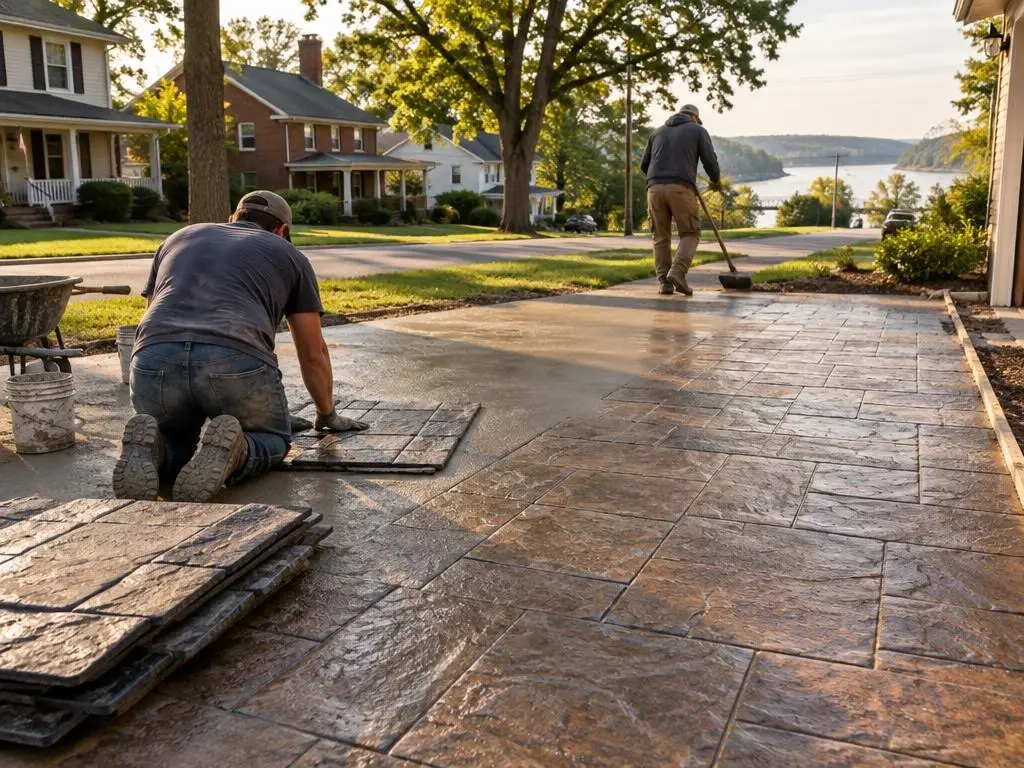
Typical Concrete Driveway Costs
| Item | Published range |
|---|---|
| Plain concrete driveway, per sq ft installed | $6 to $10 |
| One-car, 12' x 24' (288 sq ft) | $1,700 to $4,300 |
| Two-car, 20' x 20' (400 sq ft) | $2,400 to $6,000 |
| Two-car, 24' x 24' (576 sq ft) | $3,500 to $8,600 |
| Old driveway removal, per sq ft | $2 to $6 |
| Rebar, per sq ft | $1 to $3 |
| Sealing, per sq ft | $1 to $3 |
National ranges from HomeGuide's concrete driveway cost guide. Lafayette prices can differ, and removal, thickness, grading and access change the total. Your written estimate is the price.
Steps in a Driveway Project
1. Site visit
Measurements, slope and drainage, the state of the old slab, and any permit the address needs.
2. Tear-out and prep
The old drive comes out, soft pockets are dug out, stone is compacted, and forms and steel go in.
3. Pour day
Air-entrained concrete is placed, textured with a broom and jointed.
4. Curing and sealer
No vehicles for roughly a week; sealer goes on after the cure period.
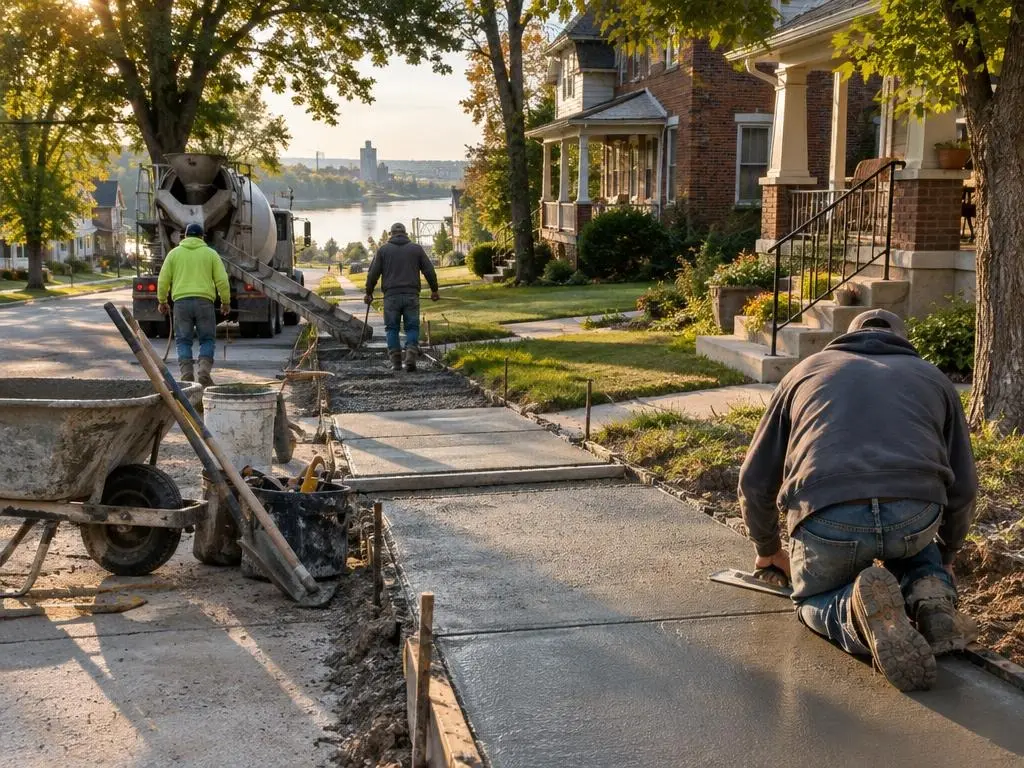
Concrete Driveways Questions
What thickness should my driveway be?
HomeGuide's guide sets 4 inches as the floor for passenger cars, 5 to 6 inches for RVs or heavy vehicles, and 6 to 8 inches at thickened edges. Where tires turn at the apron, we often add depth.
Is rebar better than wire mesh?
For drives, we lean on rebar set on chairs, because it holds its position in the middle of the slab and keeps cracks tight. Mesh helps only if it ends up inside the concrete, not trampled down into the stone.
Can new concrete go on top of my old driveway?
Seldom a good idea. A thin overlay tends to crack right above the old cracks, and the extra height causes trouble at the garage door and the street. HomeGuide lists tear-out at $2 to $6 a square foot, and it is usually money well spent.
What lifespan can I expect?
HomeGuide puts a well-maintained concrete driveway at 30 to 40 years. Entrained air, solid stone underneath, regular sealing and light use of salt push it toward the top of that range.
Is a permit involved?
Depends on the town. West Lafayette requires a right-of-way permit for work in the public right of way, and Lafayette requires one when soil is disturbed between the sidewalk and street. We look up your address before setting a date.
Concrete Driveways Service Areas
- Concrete Contractors in Lafayette, IN
- Concrete Contractors in West Lafayette, IN
- Concrete Contractors in Wea Township, IN
- Concrete Contractors in Battle Ground, IN
- Concrete Contractors in Dayton, IN
- Concrete Contractors in Shadeland, IN
- Concrete Contractors in Clarks Hill, IN
- Concrete Contractors in Otterbein, IN
- Concrete Contractors in Brookston, IN
- Concrete Contractors in Delphi, IN
- Concrete Contractors in Flora, IN
- Concrete Contractors in Monticello, IN
- Concrete Contractors in Frankfort, IN
- Concrete Contractors in Rossville, IN
- Concrete Contractors in Mulberry, IN
- Concrete Contractors in Crawfordsville, IN
- Concrete Contractors in Linden, IN
- Concrete Contractors in Attica, IN
- Concrete Contractors in Williamsport, IN
- Concrete Contractors in Covington, IN
- Concrete Contractors in Fowler, IN
- Concrete Contractors in Oxford, IN
Get a Concrete Driveways Estimate
No-cost driveway estimates in Lafayette, West Lafayette and the surrounding towns.